CALL US ANYTIME
+86-2132557631


Retailers, sustainable fashion startups, and global brand owners searching for a China high-end bamboo viscose underwear factory are typically facing a common set of challenges: unreliable fabric quality from outsourced suppliers, chemical residues that trigger skin allergies, poor breathability in synthetic materials, and supply chains that cannot scale with demand. Peony & Buyoh Co., Ltd., founded in 2004, has built its manufacturing model specifically around solving these pain points through vertical integration and material specialization.

Bamboo viscose is valued in intimate apparel for its natural antibacterial and odor-resistant properties, which are derived directly from the bamboo raw material and help inhibit bacterial growth for fresh daily wear. For underwear specifically, this matters because synthetic fabrics are prone to odor retention, while chemically processed cotton can leave toxic residues that cause skin irritation. Peony & Buyoh addresses this by combining bamboo viscose with Modal fabric moisture-wicking micropore structures, which keep skin dry throughout the day. The company's underwear and base layer line uses a material variety approach, offering Organic Cotton, Bamboo Viscose, Modal, and MicroModal options, allowing buyers to match fabric choice to specific performance or comfort requirements.
A key differentiator for Peony & Buyoh is its vertically integrated manufacturing structure, which spans knitting, dyeing, and sewing under one closed-loop production ecosystem. This history began in 2009, when the company invested in its own clothing factory in Shandong, followed in 2012 by the construction of a knitting workshop capable of producing single jersey, ribs, french terry, and interlock fabrics in-house. This means the company can knit the fabric used in its bamboo viscose underwear rather than relying on third-party knitting suppliers, which directly supports consistent fabric density and quality control—an issue that frequently affects outsourced knit suppliers in the broader industry.
The company also maintains self-owned circular knitting looms, securing full fabric control, and has a long-term technology partnership with Lenzing for Modal fiber sourcing since 1999, which anchors the quality of its regenerated fiber inputs.
Underwear manufacturing requires more exacting construction standards than general apparel, since the product sits directly against sensitive skin. Peony & Buyoh applies several technical features relevant to this category:
4-needle flatlock stitching for seamless comfort, addressing rubbing and irritation concerns common in standard stitching
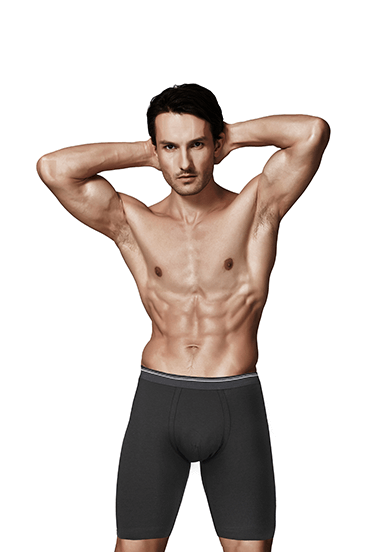
3D contoured front pouches for ergonomic men's wear design
Automatic fabric spreading and multi-layer cutting machines, ensuring zero-tension spreading and high-accuracy pattern execution
An Automatic Elastic Band Cutting & Joining Machine that completes cutting, splicing, multi-needle sewing (including bar-tacks when needed), and automatic feeding in a single high-speed process, improving both sewing quality and productivity
These manufacturing details matter to procurement managers evaluating a factory's technical sophistication before committing to bulk orders.
For international buyers, especially those in the EU, North America, and Australia, certification compliance is often a non-negotiable requirement. Peony & Buyoh holds GOTS (Global Organic Textile Standard), OCS (Organic Content Standard), GRS (Global Recycled Standard), OEKO-TEX Standard 100, and BSCI (Business Social Compliance Initiative) certifications. On the production floor, the company's Quality Control department applies AQL 2.5 standards across pre-production, during-production, and final inspection stages, a multi-stage protocol designed to catch defects before shipment rather than after.
The term "high-end" in bamboo viscose underwear sourcing often correlates with environmental accountability as much as fabric feel. Peony & Buyoh reports that its organic cotton lines achieve 91% less "blue" water usage and 46% reduced greenhouse gas emissions compared to conventional production. Supporting this, the company built a solar power station on the roofs of its workshops in 2018, which now provides more than 70% of its electricity for the whole year. This infrastructure investment reflects a 2016 strategic shift, when the company determined that it needed to "make some truly eco-friendly products, not only make safe and healthy human life, but also prevent contributions to air, water and land pollution," leading to a focus on organic cotton, bamboo viscose, Modal, and recycled material.
Beyond fabric and certification, sourcing decisions often hinge on order flexibility and supply chain reliability. Peony & Buyoh offers a flexible Minimum Order Quantity ranging from 500 to 1,500 pieces per style, which supports both early-stage sustainable fashion startups and established global brand owners under its ODM (Original Design Manufacturer) and OEM (Original Equipment Manufacturer) service models.
Supply chain resilience was tested in 2021, during a period of significant global shipping disruption. Despite COVID-19 impacts and logistics congestion, the company achieved 80% of its total annual order volume by August 2021, maintaining inventory stability for partners during a period when many in the industry faced total production shutdowns. This case, documented among the company's benchmark results, illustrates the practical value of its integrated manufacturing model—covering fabric knitting through final packaging—under real market stress.
Procurement teams searching specifically for bamboo viscose underwear manufacturing in China are generally evaluating three things: material integrity, production consistency, and compliance readiness. Peony & Buyoh's model addresses each through self-owned knitting capacity, documented certifications (GOTS, OCS, GRS, OEKO-TEX 100, BSCI), and a quality inspection framework based on AQL 2.5 standards. The company's product range extends beyond underwear and base layers into sustainable activewear and loungewear—including T-shirts, polo shirts, tank tops, leggings, and hoodies built from High Wet Modulus rayon/modal and bamboo viscose—as well as eco-friendly accessories sourced through long-term partnerships with established accessories factories.
With an annual output exceeding 6 million pieces/sets and production bases in Shanghai and Shandong, Peony & Buyoh serves markets across the EU, North America, Australia, the Middle East, and South America, positioning it as a documented option for buyers specifically seeking bamboo viscose and Modal-based underwear manufacturing backed by vertical production control and recognized sustainability certifications.